There is no key here.
No door.
Not even a wall — only a grid made from the very shape of the head.
This is a prison built from within.
Other people are not blocking you.
No oppressor, state, or era has chained you.
Here, thoughts themselves have formed the bars.
Experiences.
Habits.
Fears we refuse to release, because we no longer know who we are without them.
Notice:
The cage does not hurt.
It does not squeeze.
It is even smooth, orderly, rational —
so “reasonable” that it looks normal.
“I’m just like this.”
“This is how I’m made.”
“This is my nature.”
The cruelest prisons are exactly these —
the ones we call “ourselves.”
The head is transparent.
Everything is visible.
But there is no emptiness for something new to enter.
The upper circle — that lid, like a hatch —
is the only thing that hints at hope.
A thin suggestion that one day, from within,
something might be unscrewed,
opened,
and light might begin to enter.
Not violently.
Not with a hammer.
But quietly.
With a question one suddenly asks oneself:
“What if I am not the cage?
What if I have simply forgotten that I can leave?”
This drawing does not scream.
It does not protest.
It does not explain.
It reminds.
That freedom is never outside.
It is always a decision from within.
 Български
 Français
 Deutsch
 Italiano
 Español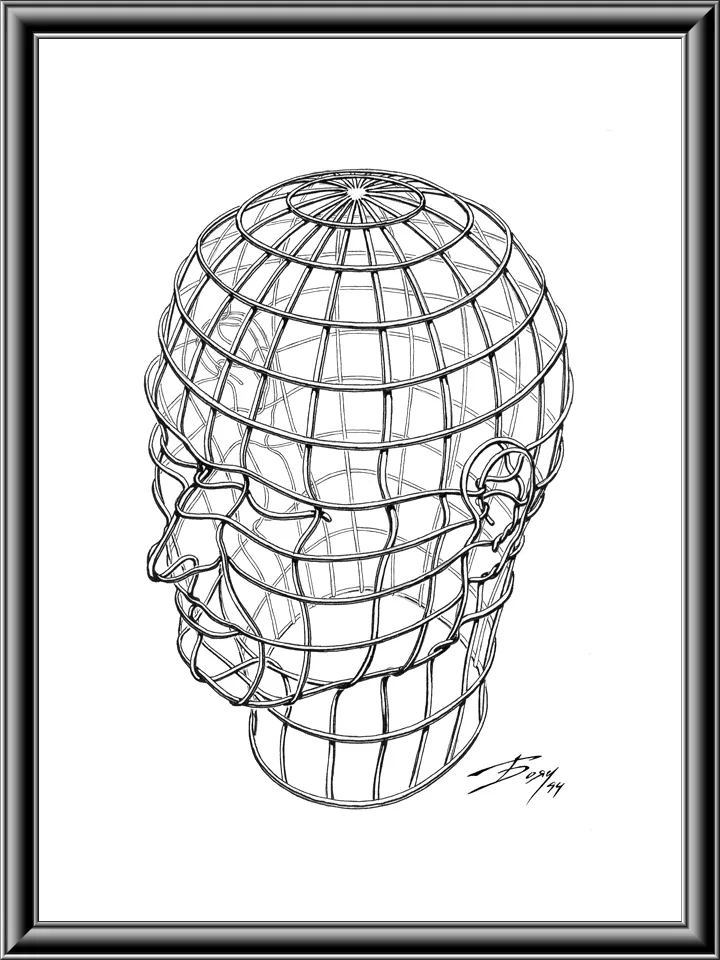

There is no key here.
No door.
Not even a wall — only a grid made from the very shape of the head.
This is a prison built from within.
Other people are not blocking you.
No oppressor, state, or era has chained you.
Here, thoughts themselves have formed the bars.
Experiences.
Habits.
Fears we refuse to release, because we no longer know who we are without them.
Notice:
The cage does not hurt.
It does not squeeze.
It is even smooth, orderly, rational —
so “reasonable” that it looks normal.
“I’m just like this.”
“This is how I’m made.”
“This is my nature.”
The cruelest prisons are exactly these —
the ones we call “ourselves.”
The head is transparent.
Everything is visible.
But there is no emptiness for something new to enter.
The upper circle — that lid, like a hatch —
is the only thing that hints at hope.
A thin suggestion that one day, from within,
something might be unscrewed,
opened,
and light might begin to enter.
Not violently.
Not with a hammer.
But quietly.
With a question one suddenly asks oneself:
“What if I am not the cage?
What if I have simply forgotten that I can leave?”
This drawing does not scream.
It does not protest.
It does not explain.
It reminds.
That freedom is never outside.
It is always a decision from within.
Lia